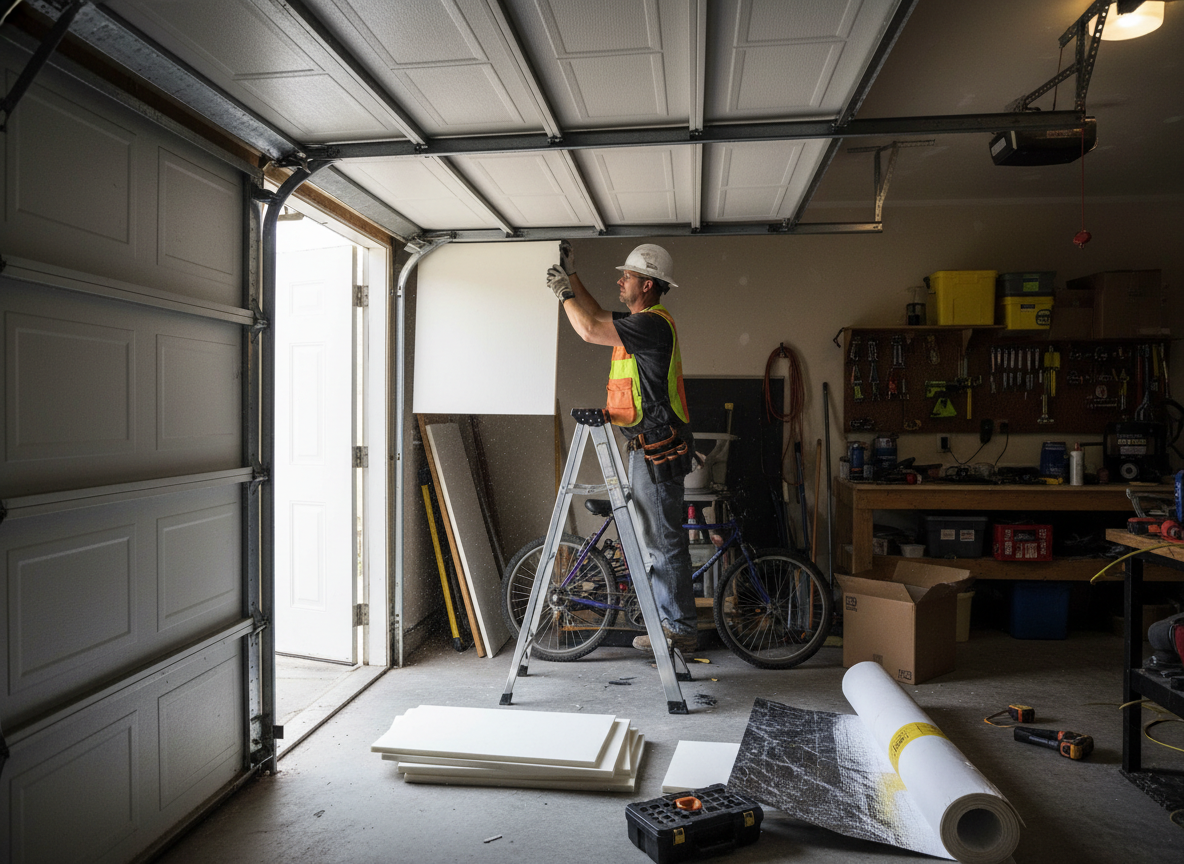
American Fork homes often have attached garages that act as thermal bridges during the cold winters and hot summers typical of Utah County. Older stock in Downtown American Fork and South American Fork commonly features single-layer steel doors with no factory insulation, allowing rapid temperature swings that affect the living spaces above. Proper garage door insulation uses rigid foam boards or reflective bubble layers cut to fit between stiles, sealed with weatherstripping at the bottom and sides to limit air infiltration from the canyon winds that funnel through American Fork Canyon.
Homeowners in North American Fork and nearby Lehi frequently discover that uninsulated doors create condensation on the ceiling joists when warm house air meets the cold garage surface. We address this by installing vapor-retardant insulation panels rated for the region's dry winters, ensuring the material stays in place without sagging on older wooden door frames common in Highland and Pleasant Grove. Edge cases include double-car doors on sloped driveways where water runoff can freeze against the bottom seal, requiring heavier bottom weatherstripping and drainage considerations not needed in milder climates.
Terrain around Timpanogos Cave and the canyon area means some garages sit partially below grade, increasing the risk of moisture wicking into insulation if the wrong material is chosen. We select closed-cell options that resist local soil humidity while maintaining R-value through repeated freeze-thaw cycles. This approach keeps the main attic space above the garage from losing efficiency, a common complaint among owners whose attics were insulated but whose garages were overlooked.
Technician insight
In American Fork, the thing that catches most people out with garage door insulation is how quickly cold canyon air drops temperatures in attached garages during winter nights, especially on homes built before the 1990s where the door sits right under the attic space. Homeowners insulate the attic but forget the garage ceiling loses heat through the thin door, undoing much of the attic work.
Downtown American Fork Garage Door
A single-story home near American Fork City Hall had an uninsulated steel door allowing cold air to chill the bedroom above. We found gaps along the bottom seal and no insulation between the stiles. We installed rigid foam panels and new weatherstripping rated for freeze-thaw cycles. The bedroom temperature stabilized without additional attic adjustments.
How it works
- 1
Site Evaluation
Measure door dimensions, check frame condition, and note exposure to American Fork's prevailing winds and temperature extremes.
- 2
Material Selection
Choose insulation type suited to the door construction and the home's proximity to cold canyon air or summer heat.
- 3
Panel Installation
Cut and fit insulation boards between door stiles, secure with adhesive, and seal all edges against air movement.
- 4
Weatherstripping and Testing
Apply bottom and side seals, then verify door operation and temperature performance after installation.
Pricing
Pricing varies with door size, number of panels, and whether older frames need reinforcement before insulation can be added.