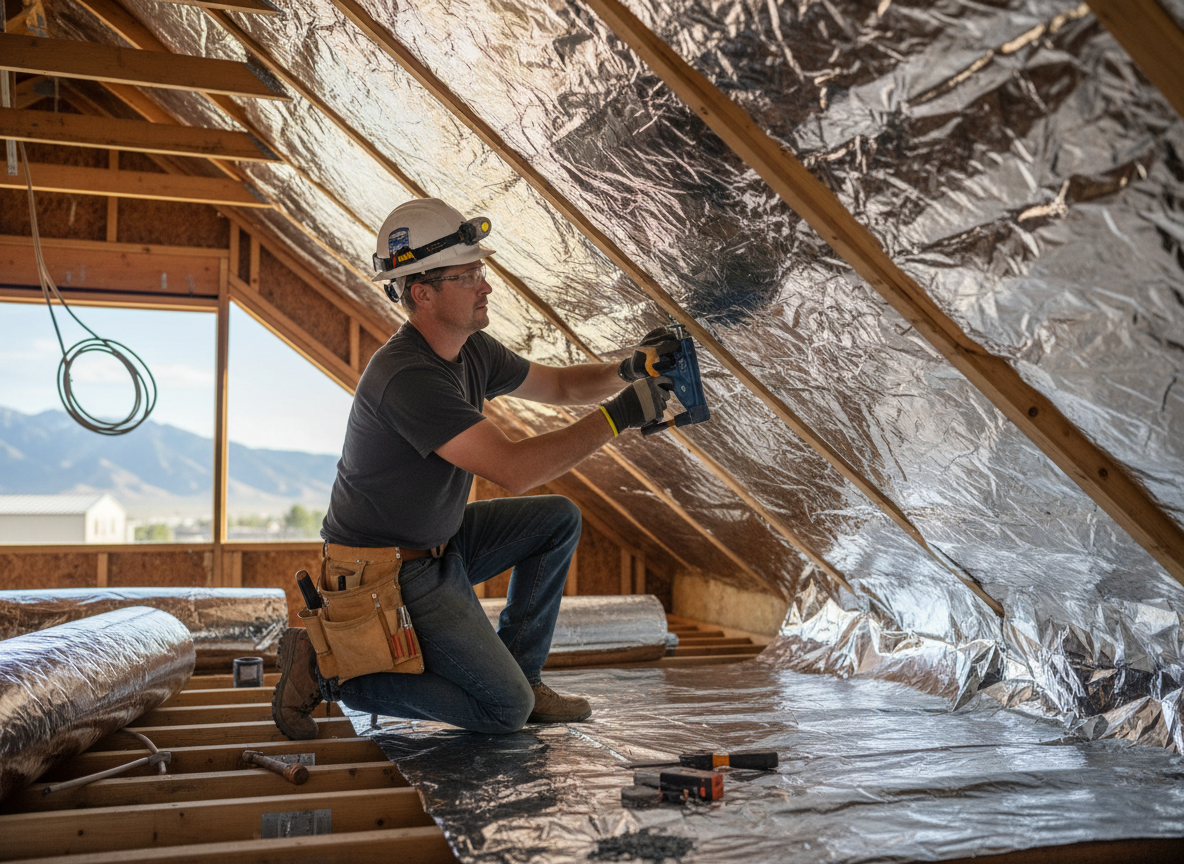
Foil insulation, typically installed as a radiant barrier, reflects up to 97 percent of radiant heat away from living spaces. In American Fork homes, this matters because the semi-arid climate brings intense summer sun that heats attics in Downtown American Fork and North American Fork neighborhoods far above outdoor temperatures. Cold winter nights then pull heat out through the same roof planes. Proper placement requires an air gap between the foil and the roof deck; without it the material loses effectiveness. Older homes near American Fork City Hall often have irregular rafter spacing that demands custom cutting to avoid gaps.
Installation crews working in the American Fork Canyon area must account for wind-driven dust and temperature swings that affect tape adhesion on seams. Foil performs differently than fiberglass or cellulose because it addresses radiant transfer rather than conduction or convection. Homeowners in nearby Lehi, Pleasant Grove, and Highland frequently request foil when they notice uneven cooling on upper floors during July afternoons. Proper sealing at penetrations prevents moisture accumulation that could corrode metal roof components over time.
Attic access in South American Fork homes built on sloped lots can limit how far crews can reach without disturbing existing insulation. Foil must be installed shiny side facing the heat source, usually downward in summer-dominant applications. Local building practices favor vented attics, so installers leave ridge and soffit vents unobstructed to maintain airflow while still blocking radiant gain.
Edge cases include homes with recessed lights or bathroom exhaust fans that require careful clearance to meet fire codes. In Utah's dry air, static can make foil handling tricky during winter installs, requiring grounded tools and careful unrolling to prevent tears.
Technician insight
In American Fork, the thing that catches most people out with foil insulation is older rafter spacing in homes near Timpanogos Cave that leaves narrow bays where foil bunches and loses its air gap during cold winter installs.
Downtown American Fork Attic Upgrade
Homeowner noticed second-floor heat buildup during summer afternoons. We found existing fiberglass settled and no radiant barrier. Installed foil sheets with proper air gap across the full attic while preserving ventilation paths. Upper floor temperatures stabilized without added HVAC load.
How it works
- 1
Site Assessment
Measure attic dimensions, note existing insulation type, and identify penetrations in American Fork homes.
- 2
Material Preparation
Cut foil sheets to fit rafter bays while maintaining required air gap and sealing plan.
- 3
Installation
Secure foil with staples or furring strips, tape all seams, and ensure vents remain clear.
- 4
Final Inspection
Check for gaps, verify shiny side orientation, and confirm no contact with heat sources.
Pricing
Cost depends on attic square footage, access difficulty, and whether existing insulation must be moved in American Fork properties.