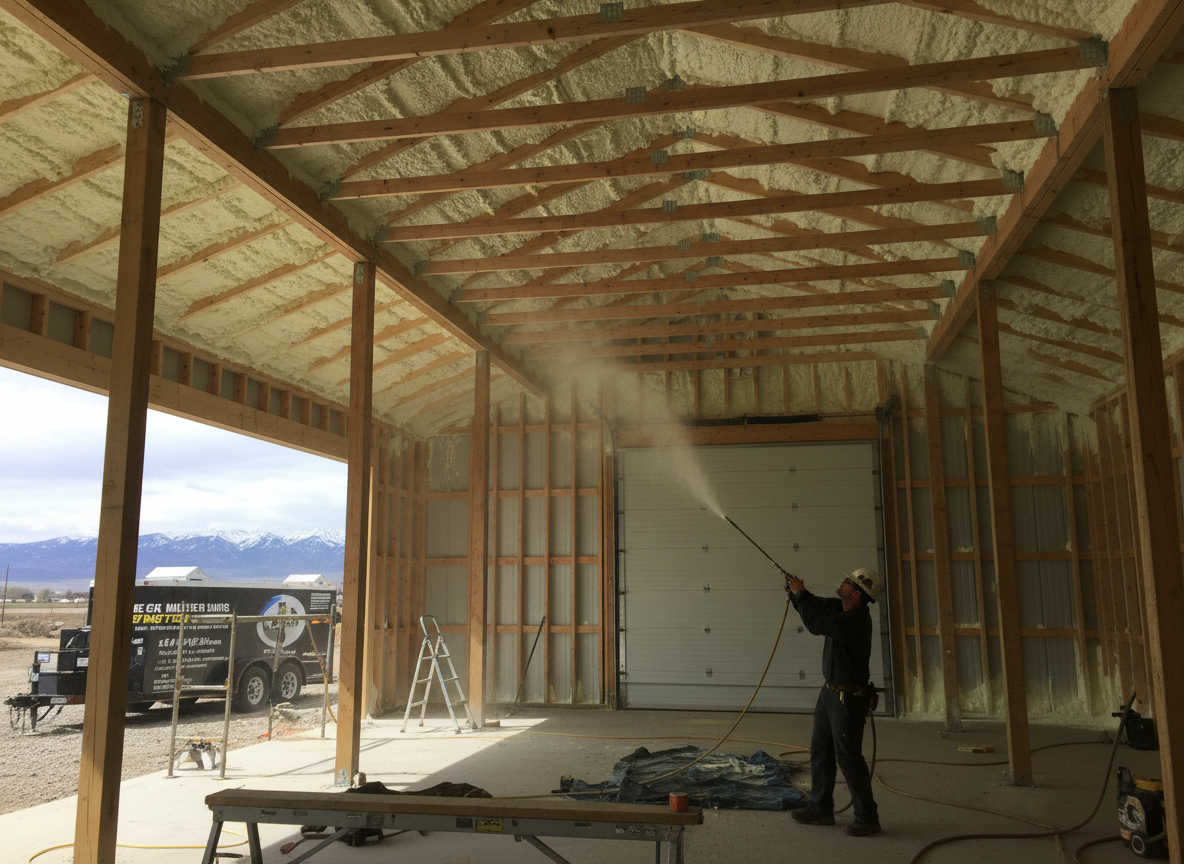
Pole barns in American Fork often sit exposed on flat lots near the canyon mouth where wind drives temperature swings. Semi-arid air pulls moisture through unsealed metal seams during cold nights, then hot summer days push heat back in. Proper insulation must address both vapor drive and radiant heat without trapping condensation against steel panels. Spray foam or rigid board systems with sealed seams outperform loose fill because they create a continuous thermal break on irregular purlins and girts common in older Utah agricultural buildings.
Homeowners in North American Fork and the American Fork Canyon area frequently discover that standard fiberglass batts fail once wind-driven rain or snow infiltrates ridge vents. Closed-cell foam applied directly to the underside of metal roofing stops this cycle and adds structural rigidity against gusts funneled down the canyon. In South American Fork and nearby Highland, barns built on slab foundations also need perimeter insulation to block ground frost heave during long winter freezes. Skipping this step leads to warped lower panels within a few seasons.
Local code in Utah County requires minimum R-19 walls and R-30 ceilings for conditioned pole barns. Installers must maintain ventilation paths at eaves when using permeable materials, otherwise trapped moisture corrodes fasteners. Edge cases include barns converted to workshops where welding or painting creates additional vapor loads that demand extra exhaust before insulation is applied. Always verify existing electrical and plumbing runs before spraying foam to avoid hidden damage.
Seasonal Guidance
Install during shoulder months when daytime temperatures stay above 50 degrees so adhesives and foams cure properly. Winter installs require heated enclosures; midsummer work risks rapid skinning of spray foam before it fully expands.
Technician insight
In American Fork, the thing that catches most people out with pole barn insulation is the constant wind off the canyon that forces moisture under every unsealed ridge cap during winter. Homeowners assume fiberglass will work like it does in houses, then watch condensation drip onto stored equipment once temperatures drop below freezing. The fix always starts with sealing the metal seams first.
Condensation in South American Fork pole barn
Owner reported dripping from the roof deck every cold night. Inspection showed open seams along the ridge and no insulation on the north wall facing canyon winds. Closed-cell foam was applied directly to the metal after sealing gaps; the barn now stays dry through winter temperature drops.
How it works
- 1
Site Assessment
Measure interior dimensions, check for existing moisture stains on metal, and note vent locations relative to American Fork Canyon wind patterns.
- 2
Material Selection
Choose closed-cell spray foam or rigid boards based on whether the barn will be heated, cooled, or used for storage only.
- 3
Surface Preparation
Clean metal surfaces, seal gaps at base plates, and protect electrical boxes before application.
- 4
Installation and Air Sealing
Apply insulation continuously across walls and roof deck, then seal all penetrations to stop air movement.
- 5
Final Inspection
Verify uniform coverage, proper R-value, and restored ventilation paths before leaving the site.
Pricing
Cost depends on barn size, chosen material, and whether the structure is already enclosed or still open-frame.